If you are of a creative mind, like the idea of customizing and selling your own clothes, or maybe even building your own brand in the long run, DTF printing should be at the very top of your list. Gone are the days when custom apparel belonged to shops with warehouse space and minimum-order contracts. Direct-to-film (DTF) printers have changed that: pretty much anyone now with a spare room can turn a design into a finished shirt. Demand is rising too. Market analysis estimates value the DTF printer market at about $2.68 billion in 2025, $2.85 billion in 2026, and $4.25 billion by 2032. Here is why DTF printing still works as a side hustle in 2026.
1. DTF Printing is an Ideal Business To Do From Home
Production is quick and fits around a day job. Each transfer takes about 2-5 minutes to make. Batching orders on evenings and weekends is realistic. Be honest with yourself about the learning curve, though. Design prep, customer service, maintenance, and pressing can add up to 10-20+ hours a week while you learn.
2. DTF Printing Is Easier Than You Think to Get Into.
Here’s a summary of how DTF printing works: the machine prints your artwork onto PET film, you coat it with hot-melt powder, cure it, and heat-press it onto the garment. It works on cotton, polyester, blends, and dark fabrics, with no weeding required. Unlike screen printing which often needs runs of 50-100 pieces to pay off, DTF allows profitable single-piece production. That makes it a good fit for a side hustle, since you can print only when orders arrive. The setup is modest. You need a printer, a Windows PC, RIP software, ink, film, powder, and a heat press. One cost analysis puts total startup between $1,700 and $12,000. You can also test demand first by pressing outsourced transfers before buying a printer.
3. It Lets You Explore Your Creativity in Very Unique Ways
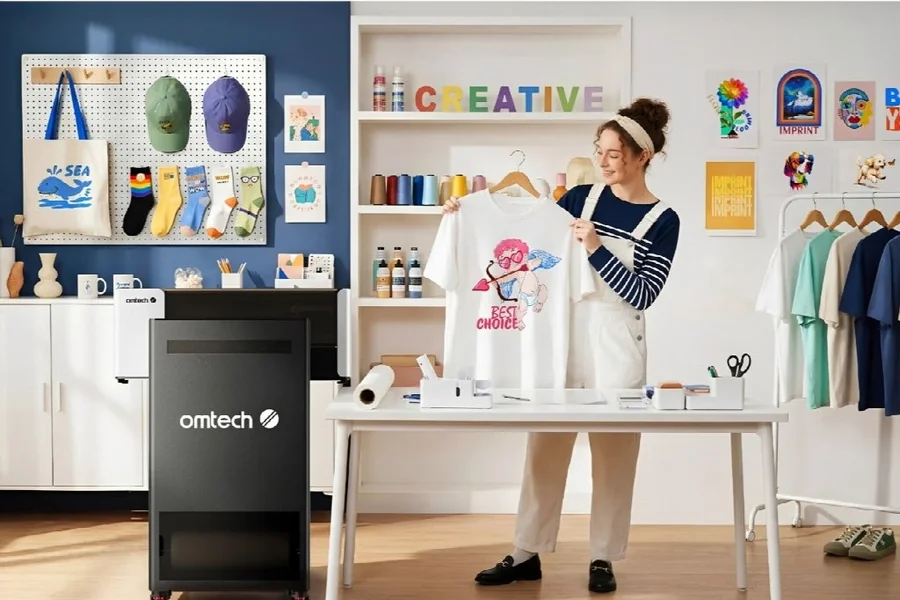
DTF handles full-color gradients, photographic detail, and fine text. You can print T-shirts, hoodies, tote bags, aprons, pet apparel, workwear, and canvas shoes. Good niches include school clubs, local events, team jerseys, personalized baby clothes, and Etsy shops. A roll-fed printer also lets you gang several designs onto one sheet, so a single print run can cover multiple customers.
4. It’s marketable for profit
You will hear a lot of people argue otherwise, but the unit economics are strong in DTF printing, and if you have good projects and decent business acumen, you have a very good chance. In-house transfers typically cost about $1.50-$5 each. Buying them from a vendor can run $4-$8 each, which squeezes your margin. Custom apparel commonly sells at a 2.5x-4x markup. For example, a $5 blank, a $3 transfer, and $1 of packaging make a $9 cost, and a 3x markup gives a $27 retail price. That is $18 of gross profit per shirt. Some analysis shows DIY DTF puts roughly $7 more per shirt in your pocket than print-on-demand. Build in a cushion for misprints and wasted film, because real margins run lower than the best-case math.
Starting a DTF Business? Consider the OMTech Aurora DTF Printers
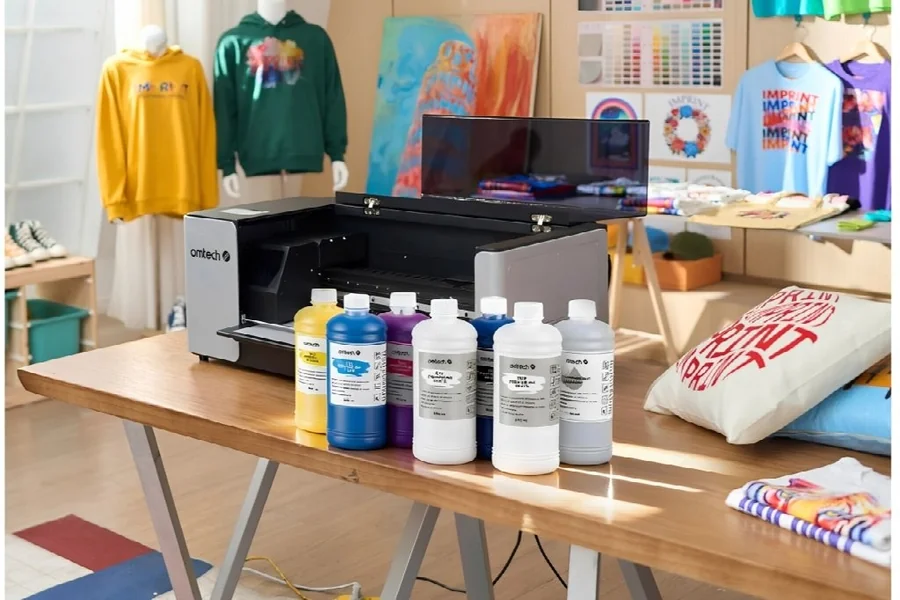
The OMTech Aurora DTF Printer with Epson printheads is built for people bringing DTF production in-house for the first time. The Aurora D1 Series (Kickstarter-backed, with $800K raised) comes in two tiers, so you can buy the capacity you need today.
Choose your capacity
- Aurora D1 (single head): Epson F1080 printhead, up to 11 sq ft/hour, from $2,799.99 for the printer only.
- Aurora D1 Pro (dual head): dual Epson i1600 printheads, up to 50 sq ft/hour, $4,299.99 for the printer only (list price $5,499.99). Prices were current at the time of writing.
- Shaker & Dryer bundles: $3,799.99 (D1) and $5,099.99 (D1 Pro), adding an all-in-one powder shaker and dryer for a smoother post-print workflow.
Key features
- Print quality: CMYK plus white ink, up to 720 × 1800 DPI on the Pro (720 × 1440 on the D1), with G7 color standard support for accurate colors and even gradients on light and dark fabrics.
- 15″ roll-fed printing: It supports a 164-ft film roll, which is roughly 205 sq ft of film. At maximum rated speed, the Pro could in theory print a full roll in about 4 hours, versus about 19 hours on the single-head D1. A 10″ × 12″ chest print uses about 120 sq ft per 144… correction: about 0.83 sq ft, so the Pro’s top speed works out to roughly 60 such prints per hour in theory. Real throughput will be lower.
- Intelligent maintenance: White ink clogs are the classic DTF headache, especially for part-timers. The Aurora circulates and stirs white ink automatically and runs printhead cleaning and moisturizing every 12 hours. With the printer kept powered on, standby protection covers up to two weeks between production runs. It also gives low-ink alerts at about 25% and has electric ink refill.
- Starter consumables included: Printer-only packages come with five 250 mL CMYKW ink bottles, a 15″ × 164 ft film roll, 250 mL of moisturizing liquid, and 500 g of transfer powder.
- Compact footprint: It measures 31.1 × 19.1 × 12.3 in and weighs 77-79 lbs, so it fits a workbench in a spare room or garage.
- Support: Support includes free virtual technical support, VIP 1-on-1 WhatsApp guidance from unboxing to operation, and a beginner video guide. You can also try demo rooms, finance through Affirm or Clicklease, and get free shipping, with orders shipping in about one business day.
OMTech’s online DTF Business Estimator (check the product link above) lets you plug in your own prices and volume. Its example is a $25 classic cotton T-shirt at 100 orders per month. That works out to about $13.49 gross profit per shirt, about $1,349 per month, a 54% gross margin, and a 3.6-month equipment payback. These are editable planning figures, not earnings guarantees, and your results will depend on pricing, waste, labor, and demand.
What you’ll still need
Be realistic about the full setup. You’ll need a Windows PC, since the OMTech Print / Honsonsoft RIP software is Windows-only. You’ll also need a heat press, plus compatible ink, film, and powder. Printer-only configurations also need a separate powdering and curing solution, which is why the Shaker & Dryer bundle suits beginners. For a small business, consider buying the Aurora D1 DTF machine with an OMTech Heat Press Machine as a package deal, so you can get a good discount.
Start Small, Scale Smart
DTF works as a side hustle because it needs little space, has no minimum orders, and carries healthy margins. The Aurora D1 lets you start lean at $2,799.99 and grow into the dual-head Pro. Its automated white ink care also cuts down on the maintenance that sinks many first-time DTF buyers. Explore the Aurora D1 Series and run your own numbers in the estimator.